Barbarian Days
An ode to the boys of summer.

In the June episode of Tales From the Green Valley, as the farmers construct a large bonfire in a field, a guest historian mentions something I’d never considered before: that summer was once the most dangerous time of the year.
This was partly due to the swarms of fair-weather insects which spread disease, but also because raiding parties used the longer days to sail or trek far afield, invading villages, snatching up farm animals and, often, taking slaves. With the hope that fire’s magical protection would ward off plague and raiders, peasants thus jumped over bonfires and waved torches around the property at midsummer (from where we get our own ideas about seasonal celebratory bonfires).
This lends summer a nice savage quality, easily forgotten now that we associate the season mostly with vacation. (Indeed, this seems to be a common pattern now, that once vitalist elements of our life have been smothered into placid enjoyments.)
It’s fitting, then, that I spent most of the summer reading the first part of Augustine’s City of God alongside Montesquieu’s Considerations on the Causes and the Greatness of the Romans and their Decline, both of which deal with the fall of Rome —the eternal subject.
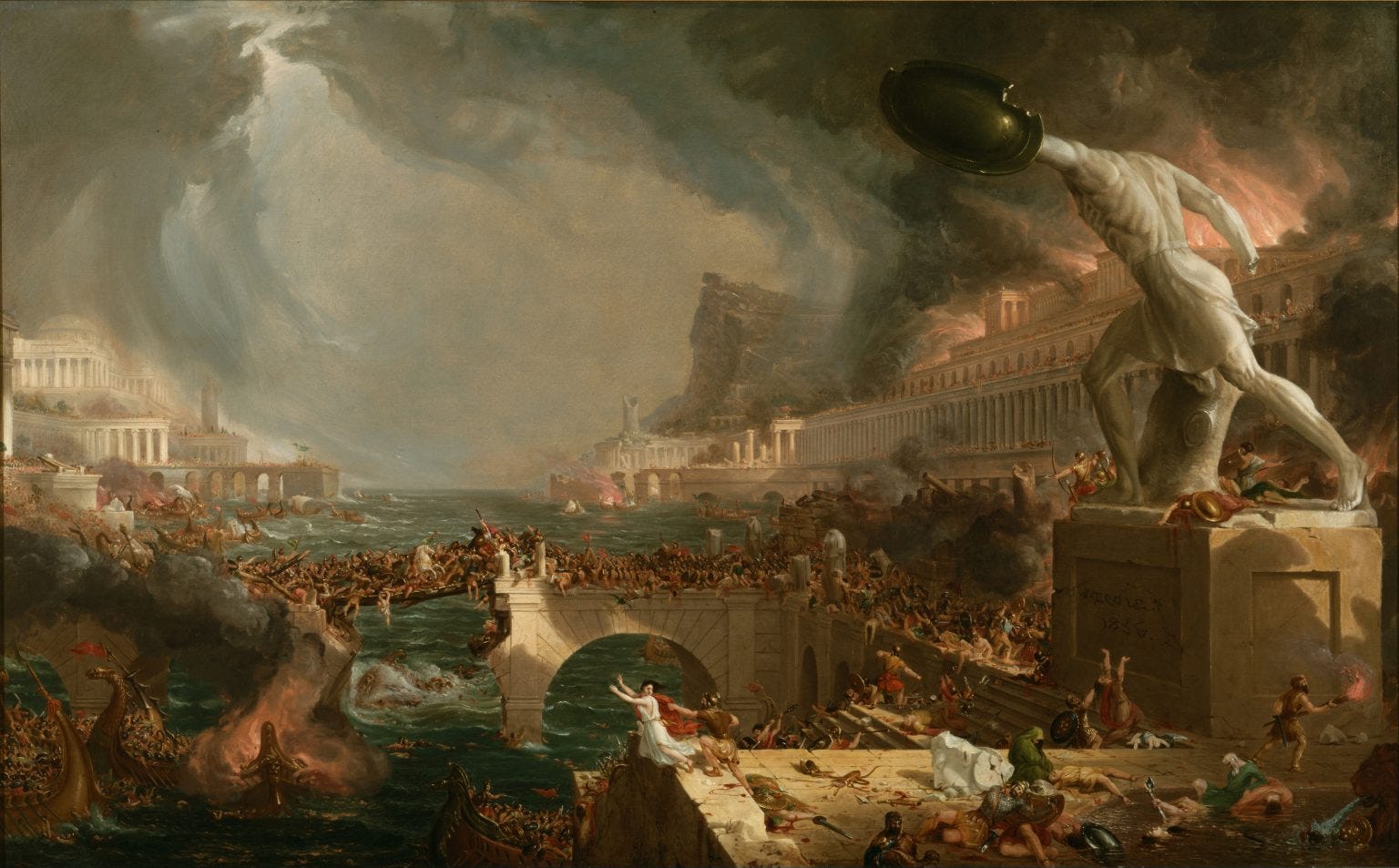
City of God was written while barbarian attacks on the Roman Empire were eating away at it. Augustine died in the midst of such a siege in present-day Algeria, part of Roman-Africa. Germanic invaders burnt his entire city, but miraculously spared the cathedral library that contained all of his works (they were Arian Christians, so perhaps it was more than coincidence.)
In 1734, French judge and political philosopher Montesquieu published an investigation into the greatness of Rome and its subsequent collapse. He and Augustine differed considerably in their perspectives. City of God is partially a rebuttal against those who blamed Christianity for Rome’s fall. Montesquieu spends relatively little time on religion. He does devote one large section to the problems of Christian monks meddling with matters of state. Small wonder, given that Montesquieu greatly advanced the idea of separation of powers, and was skeptical of any church and state fusion.
But, in other ways, the two men overlap, particularly when they praise the profound and austere discipline of Roman culture at its peak.
Our ancestors are always calling our bluff on how much more “advanced” we are now, in the presumably oh-so-modern era. More advanced in our physical capacities? Our moral standards? Hardly. In his chapter “The Art of War Among the Romans”, Montesquieu’s description of Roman legions makes any modern army seem downright coquettish.
According to Montesquieu, legions were expected to march 20 to 24 miles in 5 hours while carrying 60 pounds (armor and supplies) All, of course, without “proper” footwear, as we’d define it. Such a demand is longer, faster, and weightier than many ruck march expectations for modern U.S. military branches. Add to that, after those miles of marching, soldiers had to set up a small stockade fort around their camp before retiring for the night. They also practiced with weapons that were double the weight of their regular arms, to perfect their combat abilities.
Obedience to hierarchy, tradition and chain of command was enforced to a degree we’d deem pathological today. Manlius, writes Montesquiu, put his own son to death for defeating an enemy without a proper command to do so. When soldiers began to fear war against the Mithridates, Sulla worked them so hard on infrastructure projects they begged for combat as relief. And yet, such demands were good for: “idleness was feared more than their enemy.” One punishment for misbehaved soldiers was to bleed them, which weakened them, and thus shamed them, says Montesquieu.
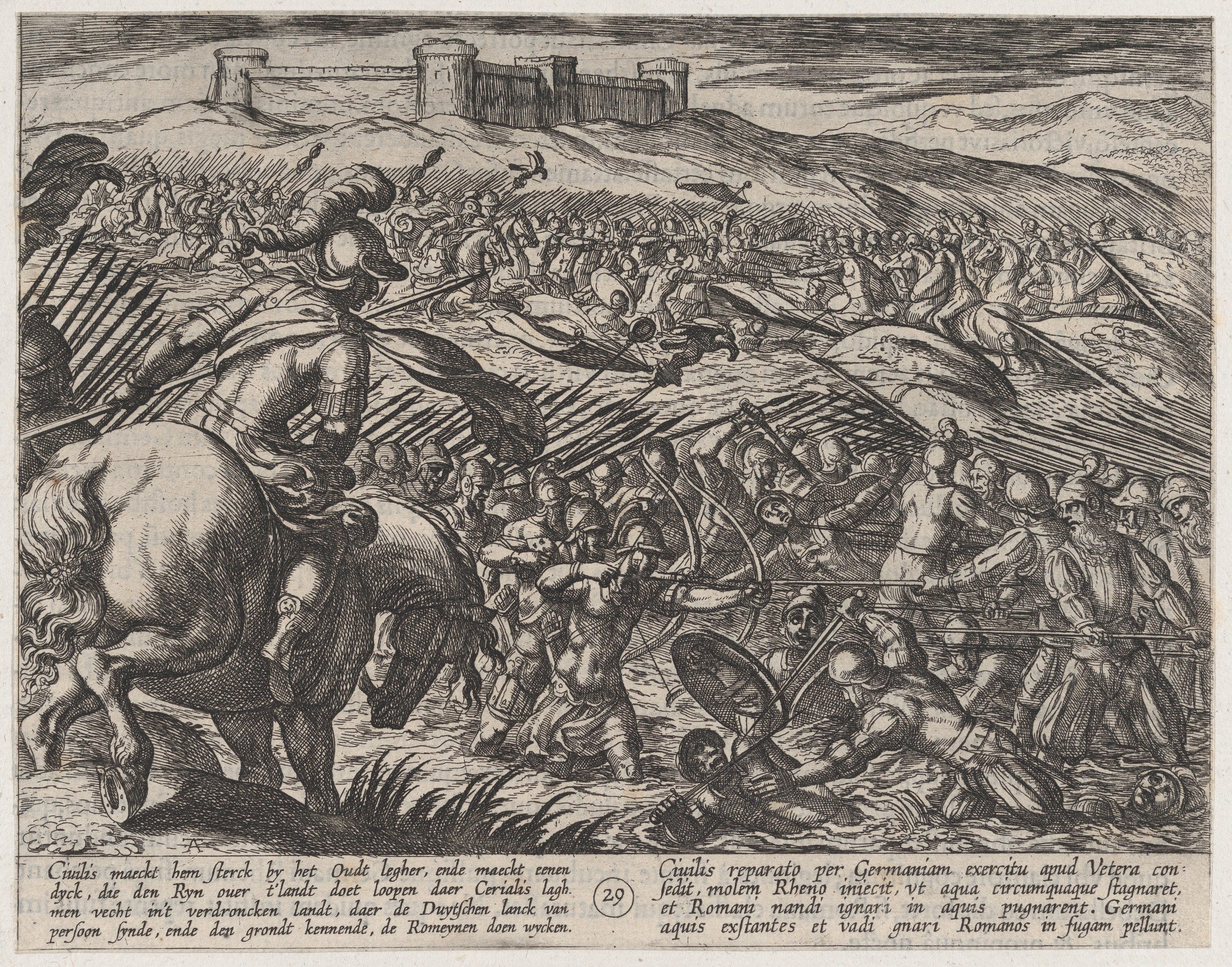
They were not sclerotic, however. “Their chief care was to examine in what way the enemy might be superior to them, and they corrected the defect immediately.” They were defeated only once by advantages like sharper swords or war elephants and went out of their way to acquire “Numidian horses, Cretan archers, Balearic slingers, and Rhodian vessels,” any superior weapon or skill an enemy might possess.
Even in Montesquieu’s time, Roman war ethics seemed a touch absurd. “We no longer have the right idea about physical exercises,” he says, writing of the 1730s. “A man who applies himself to them excessively seems contemptible to us because their only purpose is enjoyment. For the ancients, however, all exercises, including the dance, were part of the military art.”
Montesquieu may have lamented the eroding art of war in France, but the British were apparently reviving it. In 1749, the British passed the Naval Articles of War, posted on every ship in its fleet. Its first commandment was unswerving allegiance to God. From there, it declared that passing intelligence to the enemy, fleeing from battle, shirking, disobeying orders, forbearing to pursue an enemy, and so on and so forth, were all punishable by death. Some 50 years later, the British Royal Navy reached global domination (we shall refrain from commenting on its current situation.)
Such institutionalized savagery has largely fallen into disrepair in our sedated post-war era, but the Strong Gods can only be subdued for so long. Behold, the latest rebrand:

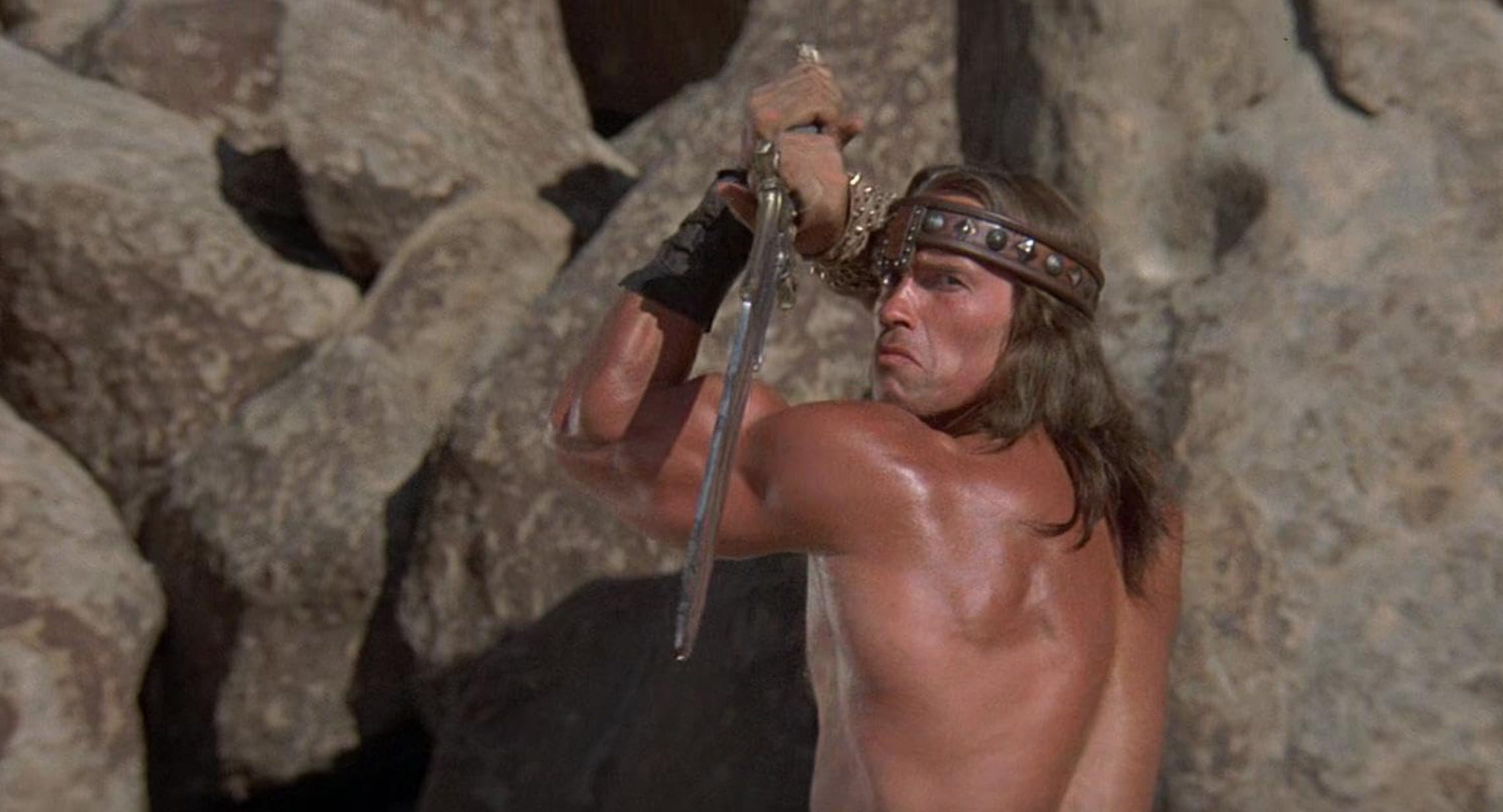
To supplement such reading with visuals, I watched Conan the Destroyer which is nearly as enjoyable as the first in the series, John Milius’ Conan the Barbarian. Both are set in the “Hyborian Age”, a fictional “vanished past” some 10,000 or so years ago, constructed by Robert E. Howard, the creator of Conan. Howard spent nearly all of his life in the small town of Cross Plains, Texas, population sub 1,000, churning out fantastical stories which gave rise to the “sword and sorcery” genre.
Watching this film, you’ll find all sorts of references to the rich symbolism of the West, which is all around us like archeological stratum, if you just know where to look.
At the opening of the film Conan is shown a vision of his lover, Valeria, on her funeral pyre. Valeria was killed in the first film, a cosmic buyback for having facilitated Conan’s resurrection from the dead via witchcraft. Such an end is a familiar reference to ancient Norse open-air cremations. It also gestures to an ancient figurine from the misty recesses of the Western imagination.
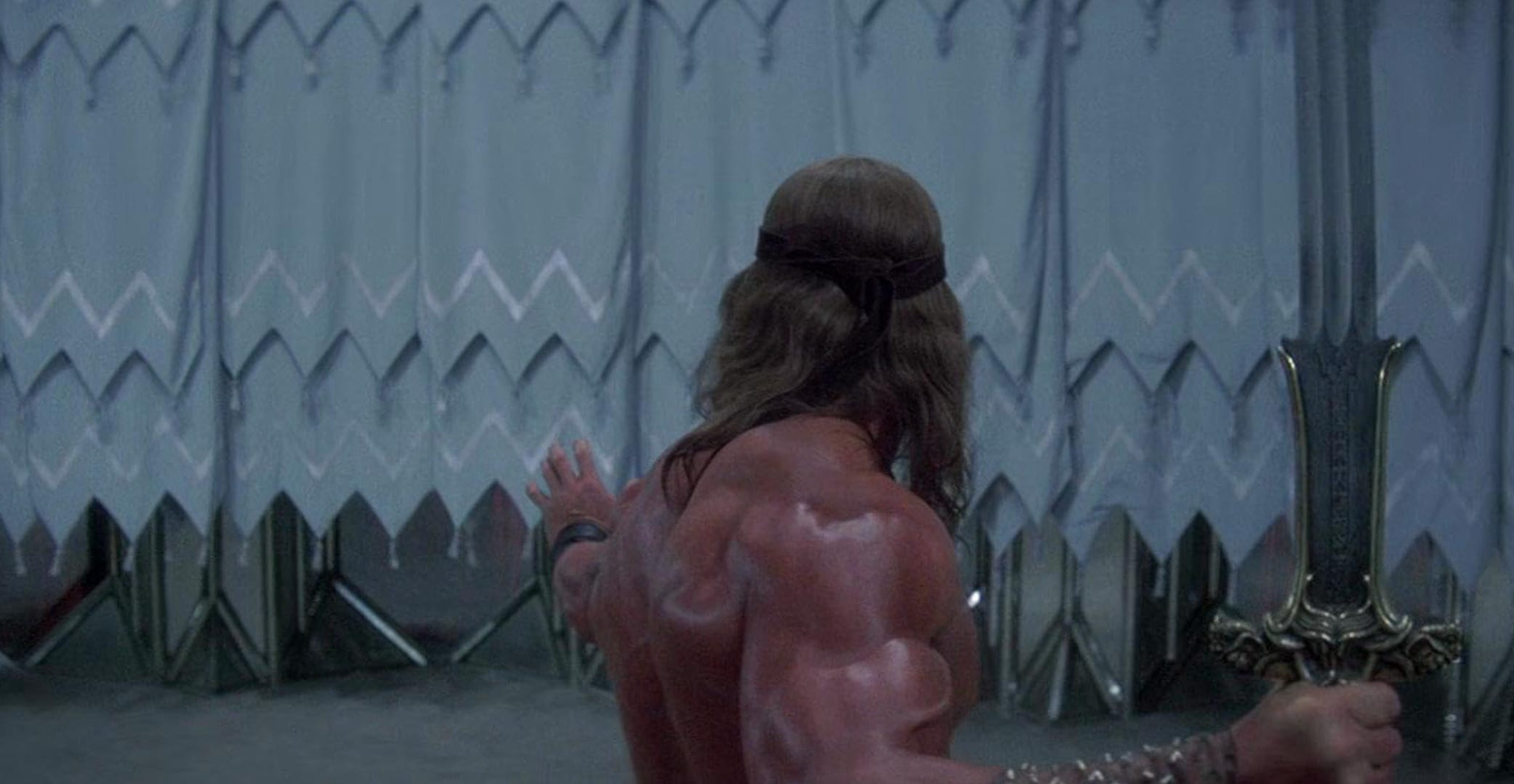
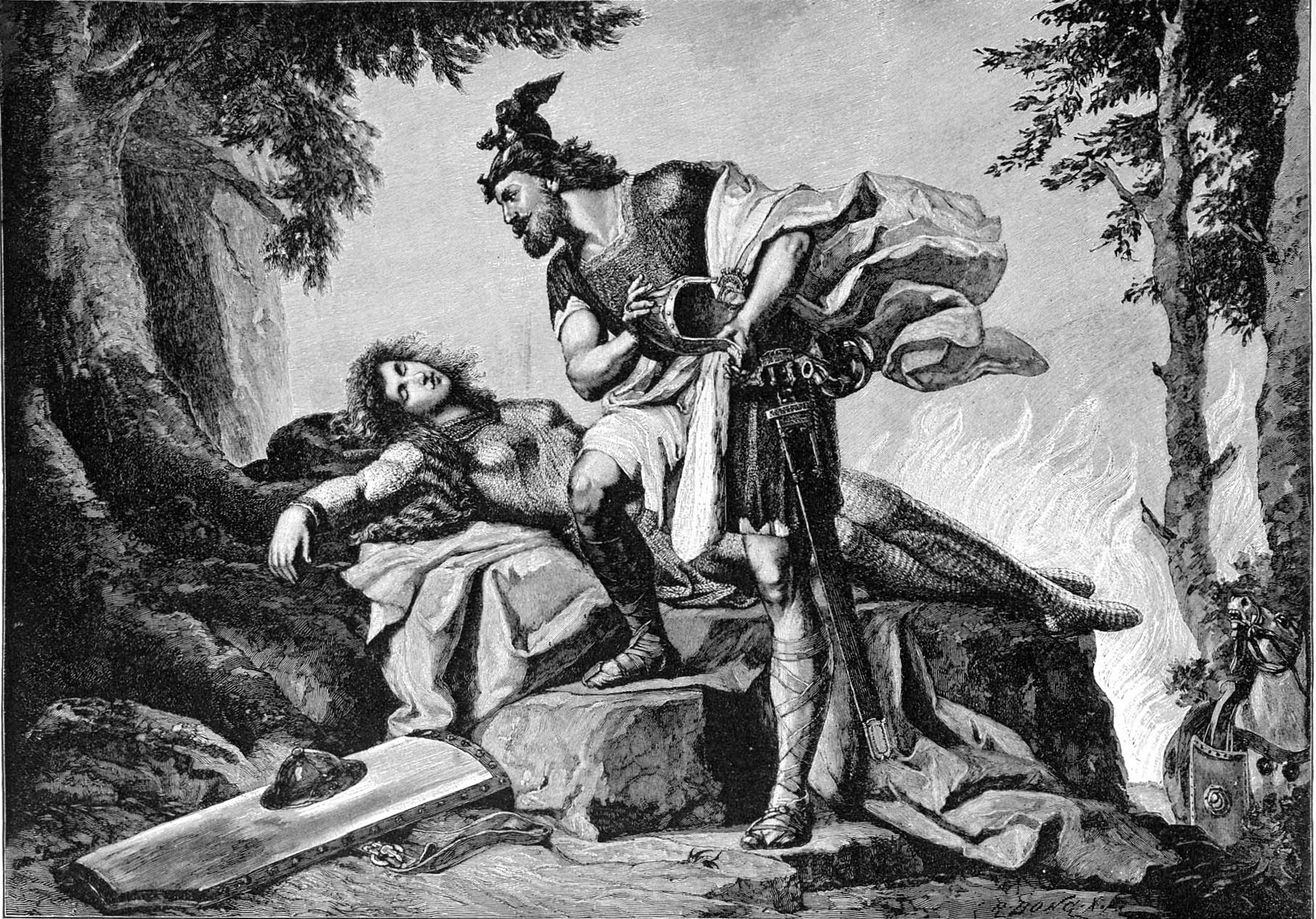
Conan is enticed into his next adventure with promises that Valeria may be brought back from the afterlife — if he does a mysterious employer’s bidding. Looking down at Valeria’s body, sill intact behind a wall of flames, we’re reminded of the Valkyrie heroine Brünnhilde in Die Walküre, the second of Wagner’s operatic Ring Cycle. Of course, Wagner drew Brünnhilde from many other olde sources, most especially the Poetic Edda, for she’s lived thousands of years in our collective Id.
After protecting the pregnant Sieglinde from death in defiance of Wotan’s wishes, Wotan curse his demi-god daughter Brünnhilde to enter into a twilight sleep on a mountainside. Whoever successfully awakens her can take her as his wife, Wotan decrees. Enraged, Brünnhilde demands that he at least ensure that only the most courageous of men get the opportunity:
If fettering sleep
is to bind me fast,
as easy prey
to the basest of cowards,
this one thing alone you must grant me
that holy fear entreats of you.
Shield the sleeper
with hideous terrors
that only a fearlessly
free-born hero
shall find me
here on the fell!
Wotan relents and erects a magic wall of flame around her. When Conan sees Valeria behind the wall of flame, tantalized with the thought he may be able to recall her from the land of the dead, we replay the challenge that the great Hero Siegfried himself undertook when crossing the flames to Brünnhilde to awaken her for his wife. And thus, to start in motion the chain of events to Götterdämmerung….
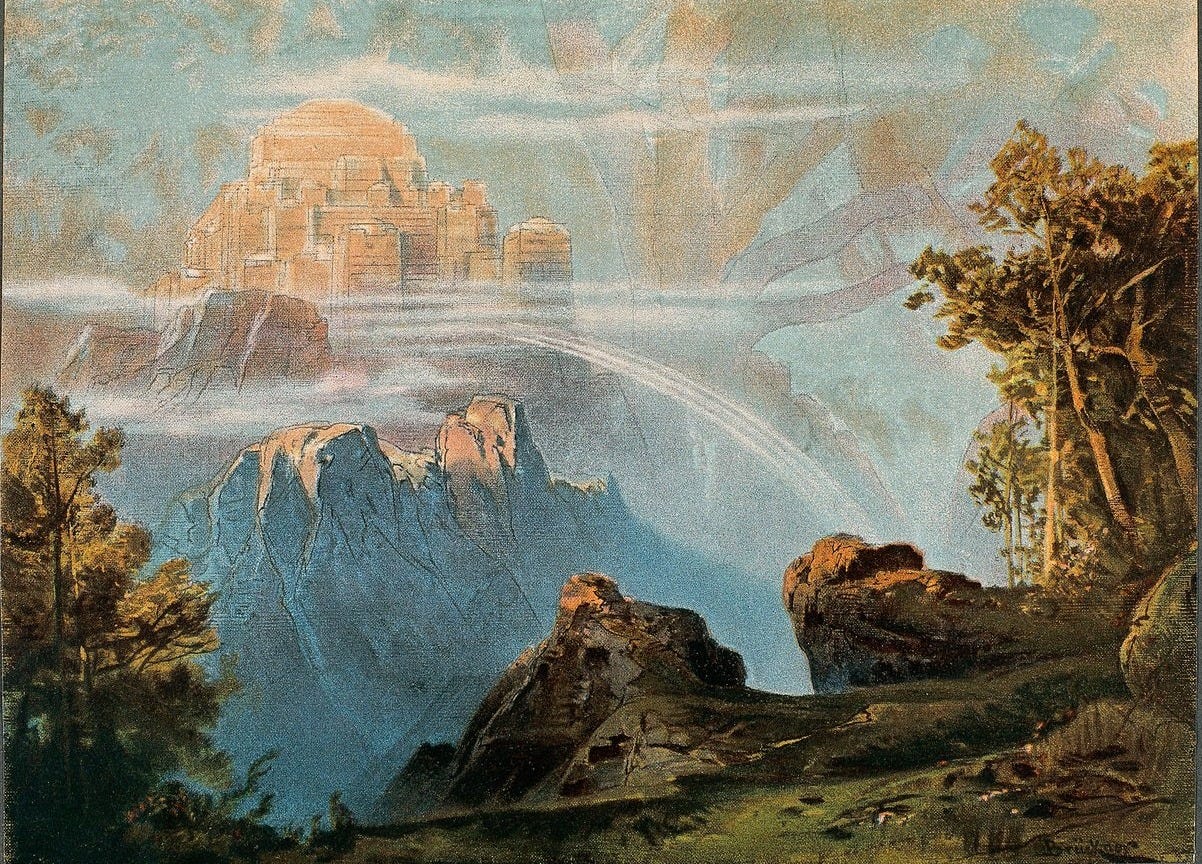
Other symbols swim up from the unconscious. Take the island lake upon which the evil wizard has built his mirrored castle. Islands within lakes are places of deep magic in the West, exemplified in the Arthurian legends of Avalon, where the morally mysterious Lady of the Lake holds court. Or, the Irish tale The Story of Conn-Eda, or, The Golden Apples of Loch Erne, in which the hero must reach an enchanted castle at the floor of a lake. Both Conan and Conn-Eda (again, overlap emerges) swim through the lake’s waters to meet their fate.
“Similarly, in the ancient mysteries of Isis and Osiris the initiate was required to pass through water, had to pass that is to say, through the threat and experience of death, whence he could emerge reborn as a “Knower," a “Comprehender,” beyond fear and released from the attachment to the perishable ego personality,” writes Heinrich Zimmer in The King and the Corpse.
Conn-Eda contains another character we may find familiar: a loyal, talking horse which must die tragically. Anyone who has seen The Never Ending Story will remember the scene with Artax, Atreyu’s loyal horse companion who drowns in the Swamp of Sadness. Similarly, Conn-Edda must kill and then flay his talking horse friend that guides him into the magical lake, in order to use the hide as a disguise to enter the underwater kingdom.
Are we more moved subconsciously by Artrax because our ancestors knew the story of Conn-Eda? Or better understand Conan’s decision to bond himself to suspicious employer, if it could free Brünnhilde/Valeria from the flames?
Wagner had thought that by deploying the right sound he could rekindle human emotions in the “stultified hearts” of his 19th-century listeners. To do so he made use of alliteration, dubbed “Stabreim” in German, which was used extensively in the ancient Poetic Edda upon which he based his Ring Cycle. (You can find bits of it all over Shakespeare too, such as the prologue of Romeo and Juliet: “From forth the fatal loins of these two foes….”)
Alliteration, Wagner thought, was the poetry of early man, having the power to unlock long dormant powers within human consciousness. “The right sound, in phonological and musical terms, would evoke a spontaneous resonance in the audience without the need for the intermediary of rational though processes,” writes Wagner translator Stewart Spencer.
Similarly, I believe the long embedded cultural symbols (“memes” I suppose) of the West can also crack open modern, calcified hearts without the “rational thought process” — but only if we are exposed to them. The rejection and denigration of the past in classroom instruction, the prioritizing of non-Western history and art, is leading to a catastrophic degradation of our collective cultural imagination from which we may never recover.
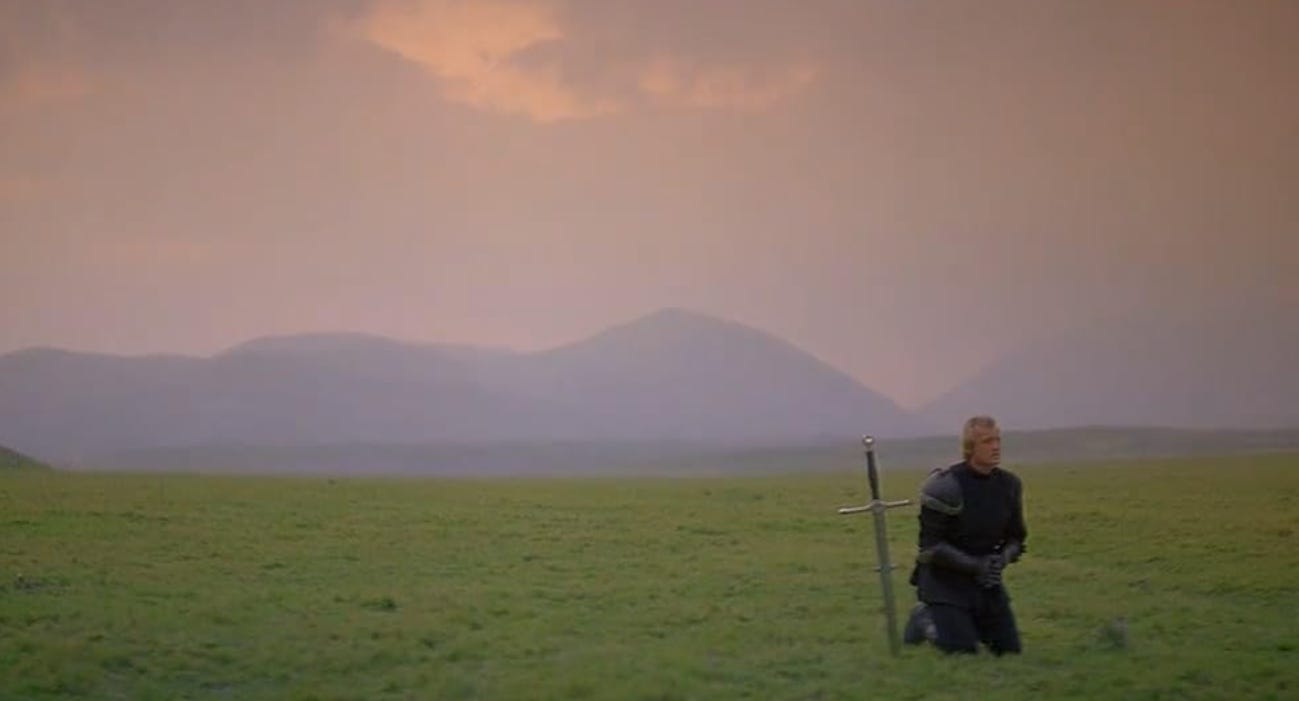
It’s a worn trope by now that they “just don’t make actors like they used to,” having swapped weathered ex-longshoremen with criminal histories for veneer-toothed “nepo babies” and “theater kids” who possess the physiognomy of Gumby. If we were to revitalize Hollywood (a romantic yet failed project) we could perhaps distribute Rutger Hauer’s autobiography All Those Moments for a little inspiration.
This entire book is a rundown of quixotic daring-do. He preforms most of his own stunts, including this daring leap in Blade Runner. He knocks out a front tooth while filming in the remote southwest and pilots a small plane back to LA for dental work. He build a giant caravan bus with kitchen and bed which he drives, gypsy-style, to his film shoots. In a collection of diary entries at the end of the book, he casually notes saving a car which was moments from careening to a fiery end over a Los Angeles cliff edge
Hauer was the son of itinerant Dutch actor-parents who left him mostly to the care of his sisters and ballerina nursemaids so that they could take far-flung theatre roles. He grew up swimming in sewage-polluted canals and skipped school often, because outside was “where the magic was.” This is another key component of the western imagination: youth spent outside, away from exams, memorization and, now, screens. (For a perfect encapsulation of how non-Westerners don’t understand what makes us Great, see Vivek Ravaswamy’s famously stupid tweet about the need to replace “hanging out at the mall” with weekend science competitions.)
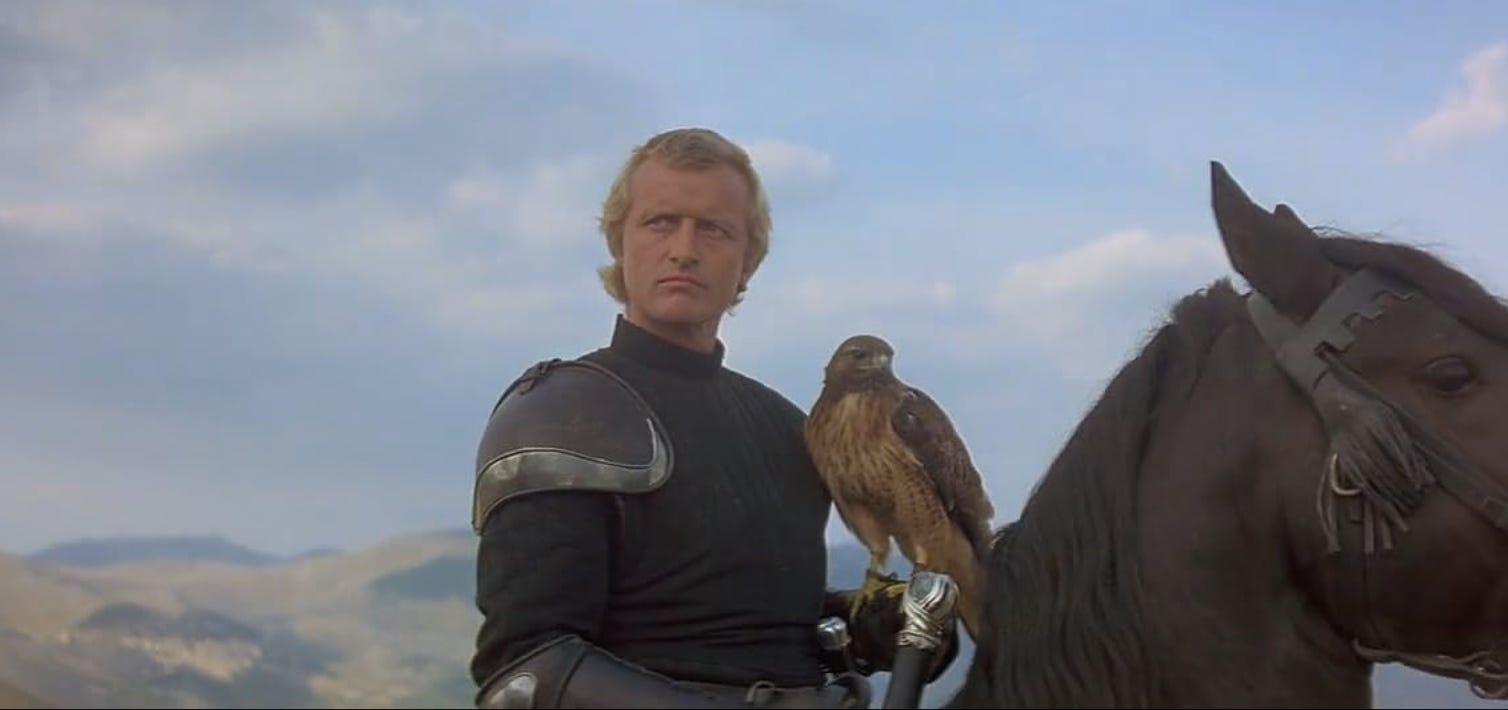
As a teenager, Hauer scrubbed decks on board merchant vessels, sailing around the world, but was ultimately rejected from a career as a ship’s captain because of color blindness. He returned to the family trade and is spotted in a rural Dutch theatre production, subsequently cast as the heroic knight in Paul Verhoeven’s TV series Floris, which launches his career. Its his skill with a sword and horse rather than robust acting chops which land him the role, however. An early fascination with the swashbuckling Gerard Phillipe in Fanfan La Tulipe prompted him to learn fencing, skills he used later in a personal Hauer favorite, the medieval romance LadyHawke.
His career peaks, perhaps, with his role as doomed Replicant Roy Batty in Blade Runner. Rutger added the famous bit: “All those moments will be lost in time, like tears in rain” to his character’s death soliloquy (which also references Tannhäuser, a medieval traveling poet and subject of Wagner’s opera by the same name.) And, he added the white dove, which apparently liked Rutger so much it had to be shooed off of his chest into flight once his character died. Similarly, the hawks used in Ladyhawke had to be swapped regularly: they grew too contented around him and puffed their feathers up in a silly manner. A special relationship with animals always signifies God’s favor.
Dashing daring-do does not always require Playboy antics, though. He retained a small Dutch farm he bought early on in his career as his primary residence. After a brief early marriage, Hauer remained with his second wife until his death. Although world-famous for starring in beer commercials, he insisted he preferred to drink “milk.” A certain type of gentle sentimentality is, too, the way of the Western male.